Stingray racing and the rising bar for software
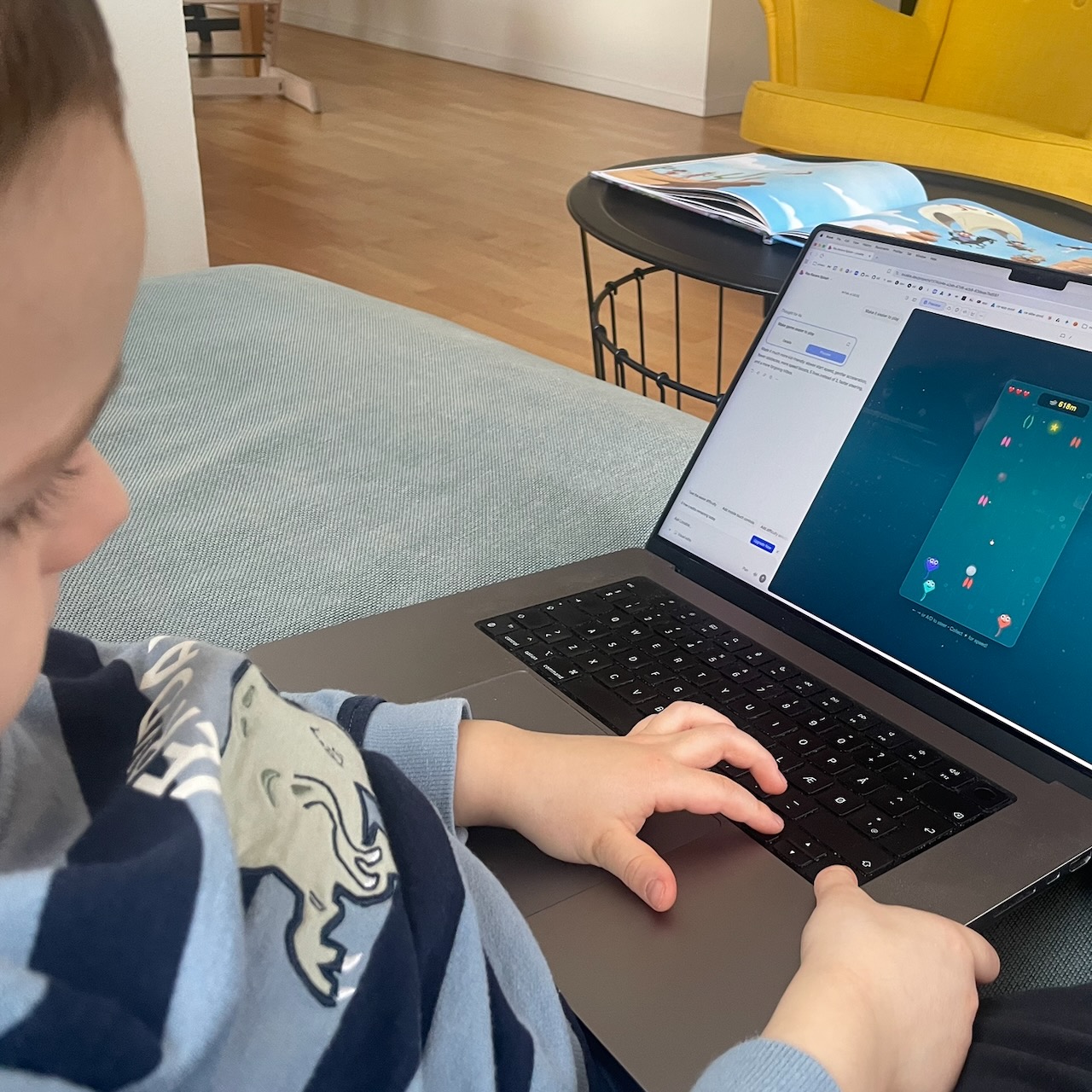
This weekend, our five-year-old son really wanted us to make our own racing game and what he wanted was super clear: only stingrays (his favorite pet animal) racing each other, and they should say “oh my days” when they crash. Using a vibe coding tool, we pretty much zero-shot a working game. Amazing that you can just do this in 10min these days! You can see the result above.
He liked it and played for a while but was also a bit disappointed that it looked nothing like Mario Kart World (his favorite game). I told him that these kinds of games are incredibly hard to make and require large, experienced teams working for years.
But I also thought: what if he is right? What if the real story of the next few years is that our expectations of what software can do, feels like, and looks like will just dramatically rise? It is a gift for small children that their imagination is not nearly as bounded as that of adults. What disappointed him felt like an aha moment to me.
I am no game designer or developer, so I have no idea what making video games will look like in a few years. But I think there is an interesting idea here that is relevant for all of software.
Will there still be a need for “professional software”?
I am also no economist or historian, so there might be better analogies. But think about making bread: of course everyone can do it (and become good at it), but this takes time, interest, and talent. This is why most people still buy bread from a store or a bakery — there is a need for a professional, convenient, scalable solution.
I think the same will hold for software. There will still be a need for thoughtful software where people thought hard about which problems to solve and how to do that reliably. A lot of engineering is thinking about the edge case, which current AI often struggles with. At the same time, professional software teams can and need to become a lot more ambitious in the kinds of problems they tackle. That is exciting but also scary as it means to costantly reinventing yourself and your product.
Probably not the best analogy between bread and software, but it is the one I could come up with right now.
What this means for individuals in software
AI-assisted engineering works very differently from traditional engineering, so there is no way around trying out a bunch of stuff and learning the new tools. They are evolving fast, so you need to keep a beginner’s mindset at all times. The people most at risk are probably mid- or senior-level engineers not adopting the tools, or young developers completely ignoring the fundamentals and just prompting their way to a system that they don’t understand and cannot reason about.
I am excited and think there is no reason to be scared if you embrace the tools.
Two useful links
I recommend the recent Pragmatic Engineer podcast with Grady Booch — really interesting to hear a software industry veteran talk about how moving up the stack has happened often in software already: https://newsletter.pragmaticengineer.com/p/the-third-golden-age-of-software
Also a nice quote from Boris Cherny, Claude Code lead, on X yesterday:
Someone has to prompt the Claudes, talk to customers, coordinate with other teams, decide what to build next. Engineering is changing and great engineers are more important than ever.